What Is Vertical Integration and Why Is It Important?
Businesses constantly look for ways to improve efficiency, reduce costs, and gain greater control over their operations. One strategy that companies use to achieve these goals is vertical integration. Understanding what is vertical integration helps business owners, students, and professionals recognize how organizations manage supply chains and expand their operations.
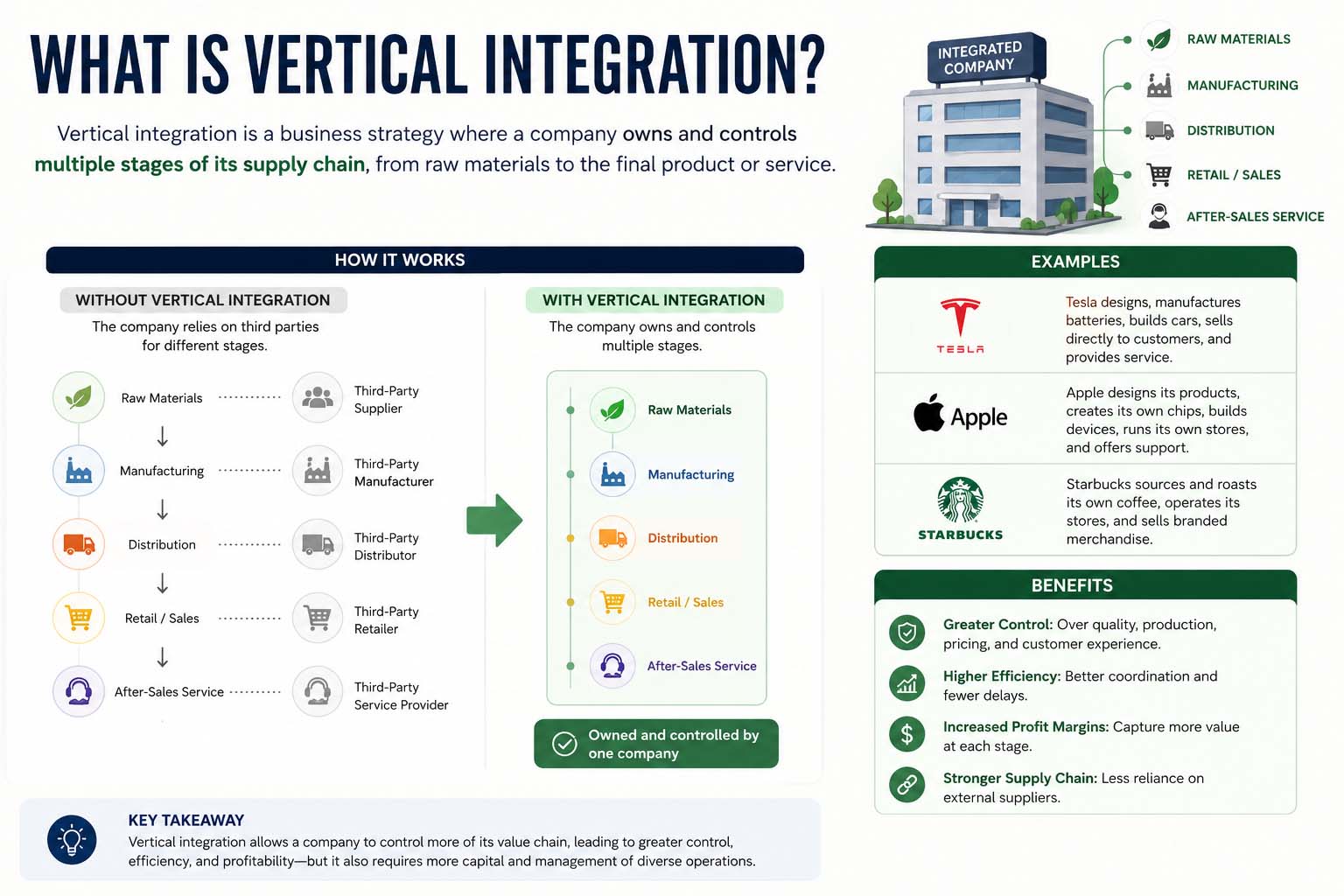
Vertical integration is a business strategy in which a company controls two or more stages of its supply chain, such as raw material production, manufacturing, distribution, or retail. Instead of depending entirely on outside suppliers or distributors, the company brings additional activities under its own ownership or control.
For example, a clothing brand might acquire a fabric manufacturer or open its own retail stores. These decisions allow the business to manage more stages of production and sales.
However, this strategy involves both opportunities and risks. Although greater control can improve coordination and product quality, expansion also requires investment, management expertise, and careful planning.
What Is Vertical Integration in Business?
Vertical integration occurs when a company expands into another stage of the supply chain rather than remaining focused on a single business activity.
For instance, a furniture manufacturer might purchase a lumber supplier to secure access to raw materials. Alternatively, it could establish its own retail stores to sell furniture directly to customers.
Both approaches represent vertical integration because the company expands beyond its original position in the supply chain.
According to Encyclopaedia Britannica’s explanation of vertical integration, the strategy involves combining different stages of production or distribution within a business organization.
Companies may pursue this approach to improve coordination, protect product quality, manage costs, or reduce dependence on external partners.
In addition, businesses developing technology and operational systems may use IT Strategy Consulting to support planning across their operations.
Types of Vertical Integration in Business
Businesses generally use two main forms of vertical integration: backward integration and forward integration.
The distinction depends on whether the company moves toward its suppliers or closer to its customers.
Backward Integration
Backward integration occurs when a business gains ownership or control over an earlier stage of its supply chain.
For example, a coffee company may purchase coffee farms instead of buying all its beans from independent growers.
This strategy can help the company secure important materials, improve coordination, and gain more control over production standards.
However, managing agricultural operations requires different skills from operating coffee shops or selling packaged coffee.
Therefore, companies must consider whether the benefits justify the additional responsibilities.
Forward Integration
Forward integration happens when a company expands into activities closer to the final customer.
For example, a clothing manufacturer may open branded retail stores rather than relying exclusively on independent retailers.
Similarly, a food producer might establish its own distribution network.
Forward integration can give businesses greater control over customer service, product presentation, and distribution.
Nevertheless, it may also introduce new costs related to transportation, retail operations, or customer support.
Balanced Integration
Some businesses expand in both directions.
For instance, a manufacturer might own important suppliers while also operating its own distribution channels.
This arrangement allows the company to coordinate several stages of its supply chain.
However, the wider operational structure can become more expensive and difficult to manage.
Benefits of Vertical Integration for Companies
Vertical integration offers several potential advantages, particularly for businesses that depend on reliable supplies and consistent product quality.
Greater Supply Chain Control
A vertically integrated company can directly manage more activities within its supply chain.
As a result, it may gain better visibility into production schedules, inventory levels, and distribution requirements.
For example, a manufacturer that owns a critical component supplier may coordinate production more closely.
However, ownership does not eliminate operational disruptions or supply shortages.
Potential Cost Savings
Businesses may reduce certain transaction costs by managing activities internally.
For instance, a company might avoid some supplier markups or coordinate transportation and production more efficiently.
Nevertheless, these savings are not guaranteed.
Operating additional facilities requires capital, employees, equipment, and ongoing maintenance.
Therefore, companies should compare the full cost of internal operations with the cost of outsourcing.
Improved Quality Management
Greater control over production can help businesses establish consistent quality standards.
A food company that manages ingredient processing and manufacturing, for example, may coordinate quality checks across both stages.
Consistent product quality can also help a business meet the expectations of its What Is a Target Market.
Better Coordination and Customer Experience
Companies that control manufacturing and distribution can sometimes respond more directly to customer demand.
For example, a retailer with its own production facilities may adjust product quantities based on sales information.
In addition, direct customer relationships can provide valuable feedback about product quality and service.
However, the benefits depend on how effectively the business manages its operations.
Vertical Integration vs. Horizontal Integration
Vertical and horizontal integration are two different business expansion strategies.
Vertical integration involves expanding into different stages of the same supply chain.
Horizontal integration involves combining with or acquiring businesses that operate at the same stage of an industry.
For example, a restaurant chain purchasing another restaurant chain generally represents horizontal integration.
By contrast, a restaurant chain acquiring a food-processing company may represent backward vertical integration.
Key Differences Between the Two Strategies
| Feature | Vertical Integration | Horizontal Integration |
|---|---|---|
| Main focus | Different supply chain stages | Same industry or production stage |
| Typical objective | Greater supply chain control | Greater market presence |
| Example | Manufacturer acquires a supplier | Manufacturer acquires a competitor |
| Potential benefit | Improved coordination | Increased scale |
| Main challenge | Managing unfamiliar operations | Integration and competition concerns |
Both approaches can support business growth, but they address different strategic needs.
How Horizontal Integration Supports Expansion
Horizontal integration allows companies to expand within their existing market.
For example, a regional supermarket chain might acquire another supermarket chain to enter additional locations.
This strategy can increase operating scale and expand the customer base.
However, acquisitions may also create challenges involving company culture, operational integration, and competition regulations.
How Vertical Integration Affects Business Operations
Vertical integration changes the activities a company performs within its supply chain.
Instead of simply increasing its presence at one stage, the business takes responsibility for additional production or distribution functions.
Therefore, the strategy often requires new technical knowledge, management systems, and operational resources.
Companies evaluating market competition may also study Cross Price Elasticity to understand how demand responds to changes in the prices of related products.
Vertical Integration Examples Across Industries
Several industries provide clear examples of how businesses can integrate different supply chain activities.
Clothing and Fashion
A clothing brand may begin by designing products and outsourcing manufacturing.
Later, the company might establish its own production facilities or open branded retail stores.
Manufacturing represents an earlier supply chain activity, while direct retail operations bring the business closer to consumers.
As a result, the company may gain more control over production schedules, product presentation, and customer relationships.
Food and Beverage
A coffee business might purchase farms, operate roasting facilities, and sell beverages through its own stores.
Each activity represents a different stage of the supply chain.
By coordinating these operations, the business may improve consistency and manage important production decisions directly.
However, agricultural production, food processing, and retail operations each require specialized expertise.
Technology and Electronics
An electronics company might design products, manufacture selected components, and operate its own retail channels.
This approach can support coordination between product development, manufacturing, and customer service.
Nevertheless, producing components internally may require substantial investment in equipment and technical capabilities.
Retail and Distribution
A retailer may establish its own warehouses, transportation operations, or product manufacturing facilities.
These investments can provide greater control over inventory movement and delivery processes.
However, businesses must evaluate whether operating these functions internally is more efficient than working with specialized partners.
Challenges and Disadvantages of Vertical Integration
Although vertical integration can improve control, it also introduces financial and operational risks.
High Investment Requirements
Acquiring suppliers, building factories, or establishing distribution networks often requires significant capital.
For example, a company entering manufacturing may need specialized equipment, production facilities, and trained employees.
Consequently, the investment can place pressure on cash flow and financial resources.
Increased Management Complexity
Operating several supply chain stages requires expertise across different business functions.
A company that previously focused on retail may need to learn manufacturing, logistics, or raw material sourcing.
Without effective management, these additional responsibilities can reduce efficiency.
Reduced Operational Flexibility
Businesses that invest heavily in their own facilities may find it difficult to switch production methods or suppliers.
For example, a company that owns a specialized factory may face high costs when changing technologies.
In contrast, external suppliers may offer alternative products or production methods without requiring the company to invest in new facilities.
Risk of Internal Inefficiency
Internal operations do not automatically perform better than independent suppliers.
An external manufacturer may have greater expertise, better equipment, or lower production costs.
Therefore, companies should evaluate each activity before deciding to bring it under direct control.
Businesses that expand into direct selling may also benefit from understanding What Is a Merchant and the responsibilities involved in commercial transactions.
When Should a Business Consider Vertical Integration?
Vertical integration may be appropriate when a company faces recurring supply problems, quality concerns, or high costs from external partners.
However, the decision should depend on a careful assessment of the company’s resources and long-term objectives.
Before expanding, business owners should consider several questions:
- Does the company depend heavily on a small number of suppliers?
- Would direct control improve product quality or delivery reliability?
- Can the business afford the initial investment and ongoing expenses?
- Does the company have the expertise to manage additional operations?
- Would outsourcing remain more flexible or cost-effective?
- Could the expansion create regulatory or competition concerns?
These questions help businesses compare potential benefits with financial and operational risks.
Vertical Integration vs. Outsourcing
Vertical integration and outsourcing represent different approaches to organizing business activities.
Outsourcing allows companies to purchase goods or services from independent providers.
By contrast, integration brings selected activities under common ownership or control.
Neither approach is automatically better.
For example, a small business may benefit from outsourcing manufacturing while concentrating on product design and customer relationships.
A larger company with predictable production needs may find direct ownership more practical.
Businesses also participate in markets through voluntary transactions, a concept explained in What Is the Voluntary Exchange of Goods and Services.
How to Implement Vertical Integration Successfully
A business should approach vertical integration as a long-term strategic investment rather than a quick solution to operational problems.
Identify the Supply Chain Problem
First, determine which part of the supply chain creates the greatest challenge.
For example, a manufacturer may experience repeated delays because a critical component supplier cannot meet demand.
Understanding the specific problem helps the company evaluate whether integration would provide a meaningful improvement.
Evaluate Financial and Operational Costs
Next, compare the cost of acquiring or establishing an internal operation with the cost of continuing to use external suppliers.
Include expenses such as equipment, staffing, maintenance, technology, and management.
The company should also consider how long it may take to recover its investment.
Assess Management Capabilities
Before expanding, determine whether the organization has the necessary expertise.
For example, a retailer entering manufacturing may need experienced production managers and technical specialists.
Without these capabilities, the expansion could create additional operational problems.
Monitor Performance After Expansion
Finally, evaluate whether the integration achieves its intended objectives.
Useful measures may include production costs, delivery reliability, defect rates, inventory performance, and customer satisfaction.
Regular performance reviews help management identify problems and make informed adjustments.
Conclusion
Understanding what is vertical integration helps explain how companies expand their operations and gain greater control over supply chains.
The strategy involves managing additional stages of production, supply, or distribution. Backward integration moves toward suppliers, while forward integration moves closer to customers.
Potential benefits include better coordination, stronger quality management, and reduced dependence on external partners. However, businesses must also consider investment costs, management complexity, and reduced flexibility.
Unlike horizontal integration, which focuses on expansion at the same industry stage, vertical integration changes the company’s role within its supply chain.
For businesses considering this strategy, the best approach is to evaluate costs, operational capabilities, and long-term objectives before making major investments.